Before the city
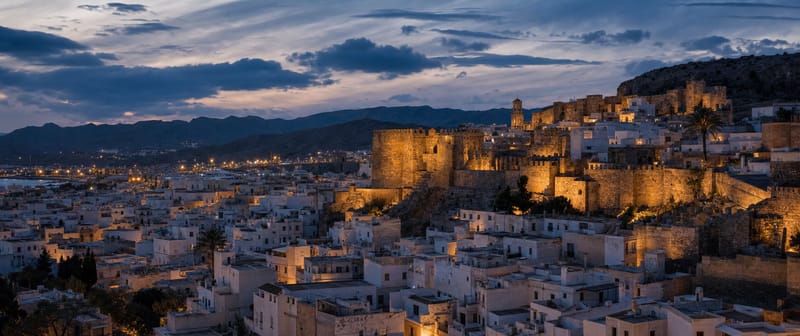
The Cerro de la Alcazaba was inhabited long before Almería existed: excavations document occupations attributed to the Bronze Age, and within today's municipal area there are Phoenician, Roman and late Roman traces. The natural harbour of the bay then depended on the inland settlement of Urci/Bayyana, present-day Pechina, the head of a territory that looked out to sea without yet living on it.
It pays to be precise: Almería as a city was founded in the tenth century, but its territory has been occupied for millennia. That difference between the place and the city explains much of what follows.
955: al-Mariyya is born
In the ninth century the coast was kept under watch against Norman raids, and a seafaring community tied to Pechina prospered on fishing and trade with North Africa. On the hill, a lookout post commanded the bay. The city's name comes from that duty: al-Mariyya, generally interpreted as “the watchtower” of Bayyana, although the etymology is debated and is best presented as a reasoned tradition rather than a certainty.
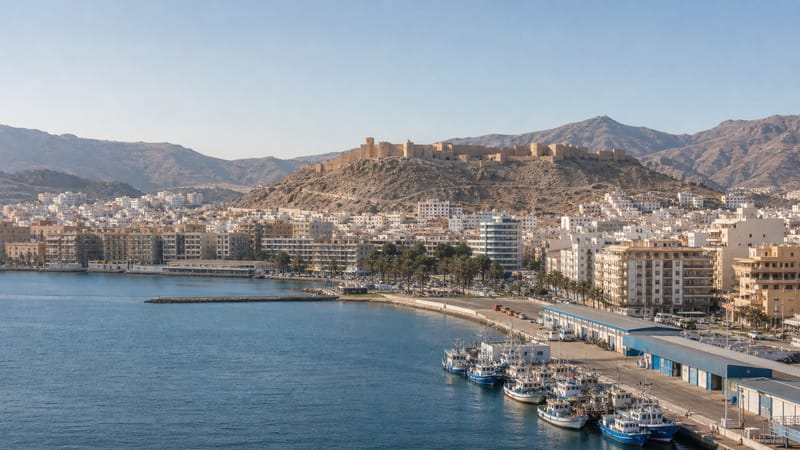
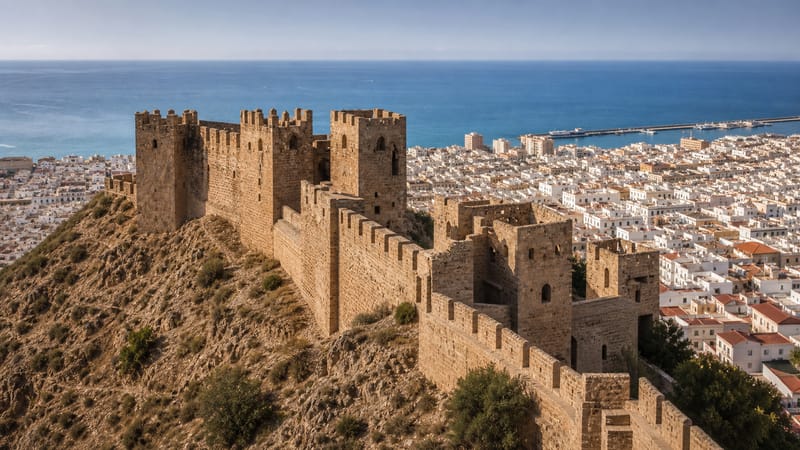
In 955 the caliph Abd al-Rahman III granted Almería the rank of city. He strengthened the fortress, ordered a great mosque to be raised and bound the medina into a system of walls. The core brought together places of worship, a souk, an alcaicería (silk market) and shipyards: a state port on the Mediterranean seaboard of the caliphate of Córdoba.
The taifa port: silk and words
After the caliphate fragmented, Jayrán took control of the city and founded a taifa kingdom. He reinforced the Alcazaba and ran a new wall up to the Cerro de San Cristóbal. Under al-Mu'tasim, the Almería court welcomed poets and men of letters while the workshops wove the silk that would make the city famous across the Mediterranean.
The port became one of the most international in al-Andalus; the suburbs of al-Hawd and the Musalla spilled beyond the original medina. The boom was cut short in 1147, when a Christian coalition led by Alfonso VII took the city; the Almohads recovered it in 1157, but the decade of war left a lasting economic mark. Almería was later absorbed into the Nasrid kingdom until the end of the fifteenth century.
A city that was, all at once, shipyard, silk market and court of poets.
1489–1522: conquest, earthquake and a cathedral with battlements
The Catholic Monarchs entered Almería on 26 December 1489; the date is still commemorated every year on the Día del Pendón. The sixteenth century, however, punished the city: it lay far from the new Atlantic routes, suffered Barbary pirate raids and, in 1522, was devastated by an earthquake.
Out of that triple threat came one of Andalusia's most singular monuments: the cathedral of the Incarnation, conceived as both church and fortress. Massive walls, buttresses, few openings and a roof fitted for lookouts and artillery. On an outer wall, the Sol de Portocarrero — a stone sun with a human face — has become the graphic symbol of the city of light.
The seventeenth and eighteenth centuries were centuries of endurance: a sparse population, droughts, difficult communications and a coast forever on guard. Even so, urban life slowly rebuilt itself; the first book printed in Almería is documented in 1640.
The nineteenth century: grapes, ore and a bourgeois new town
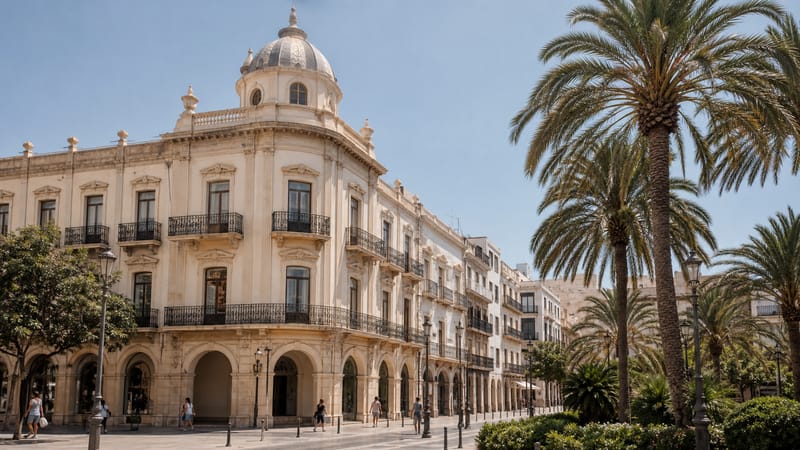
Recovery came with mining and the table-grape trade, two businesses that produced a bourgeoisie ready to transform the city. Around mid-century most of the walls were pulled down; the centre of gravity shifted from the old medina towards the Puerta de Purchena and the future Paseo de Almería, lined with eclectic architecture, cafés and shops.
The century's civic memory has its monument too: in 1824, twenty-two liberals known as “Los Coloraos”, who had landed to restore the Constitution of 1812, were shot in the city. The obelisk that remembers them — the “Pingurucho” in Plaza Vieja — remains a local emblem.
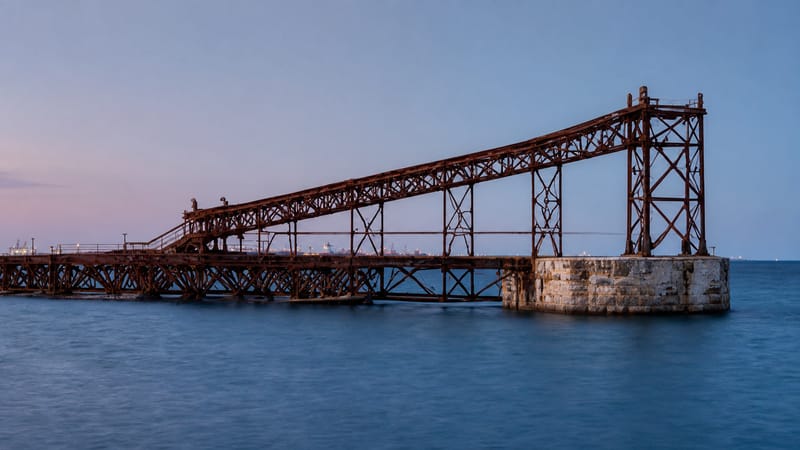
Straddling the nineteenth and twentieth centuries, iron from the Alquife mines came down to the port by train. To load it onto ships, the Cable Inglés (1902–1904) was built, an ore-loading pier of British railway aesthetics striding out over the sea beside the old station. Protected as a Bien de Interés Cultural (listed heritage) since 1998, it is the industrial counterpoint to the Alcazaba.
1937: the city underground
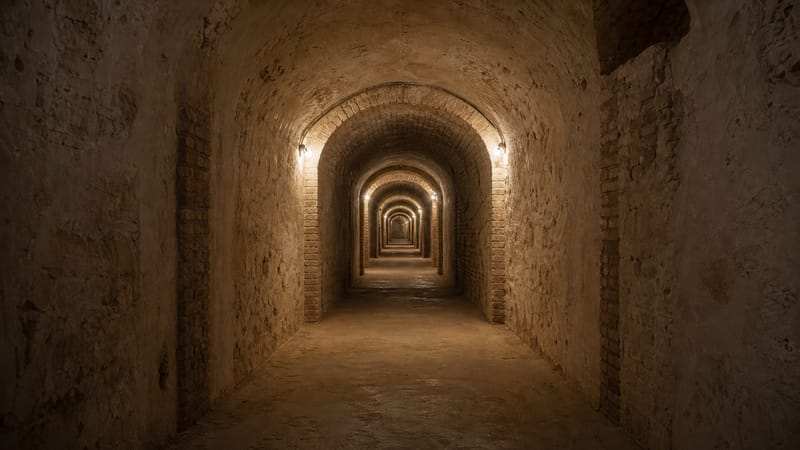
During the civil war, Almería remained in the Republican zone almost until the end and suffered air and naval attacks: municipal sources count 52 bombing raids and 754 bombs dropped on the city. The most destructive was the German bombardment of 31 May 1937.
The civilian response was extraordinary. Under the direction of the municipal architect Guillermo Langle and several engineers, the population dug some 4.5 kilometres of galleries nine metres underground, with 67 entrances, designed to shelter more than 34,000 people. Today part of the network can be visited, including a former operating theatre, in one of the most haunting museums in Andalusia.
From market gardens to the present
From the 1960s onwards, intensive agriculture under plastic transformed the economy of the province and the landscape of the poniente, to the west; the capital grew towards the Carretera de Ronda, the Vega de Acá and the Andarax, turning from a horizontal city into a vertical one. In parallel, the light and the landscapes drew the great international film shoots: that story is told in the cinema and music guide.
The monumental walk: from the fortress to the shore
The best introduction to Almería is a downhill stroll that links its historical layers in a single morning. This is the natural order:
1 · The Alcazaba
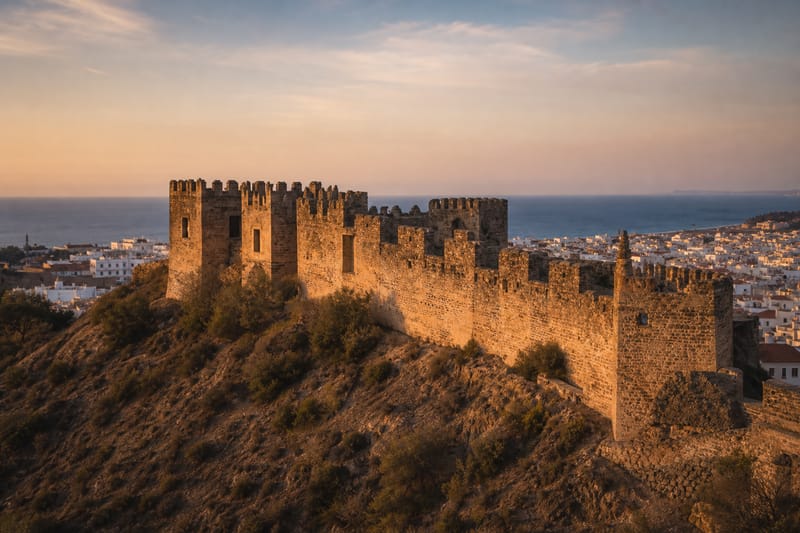
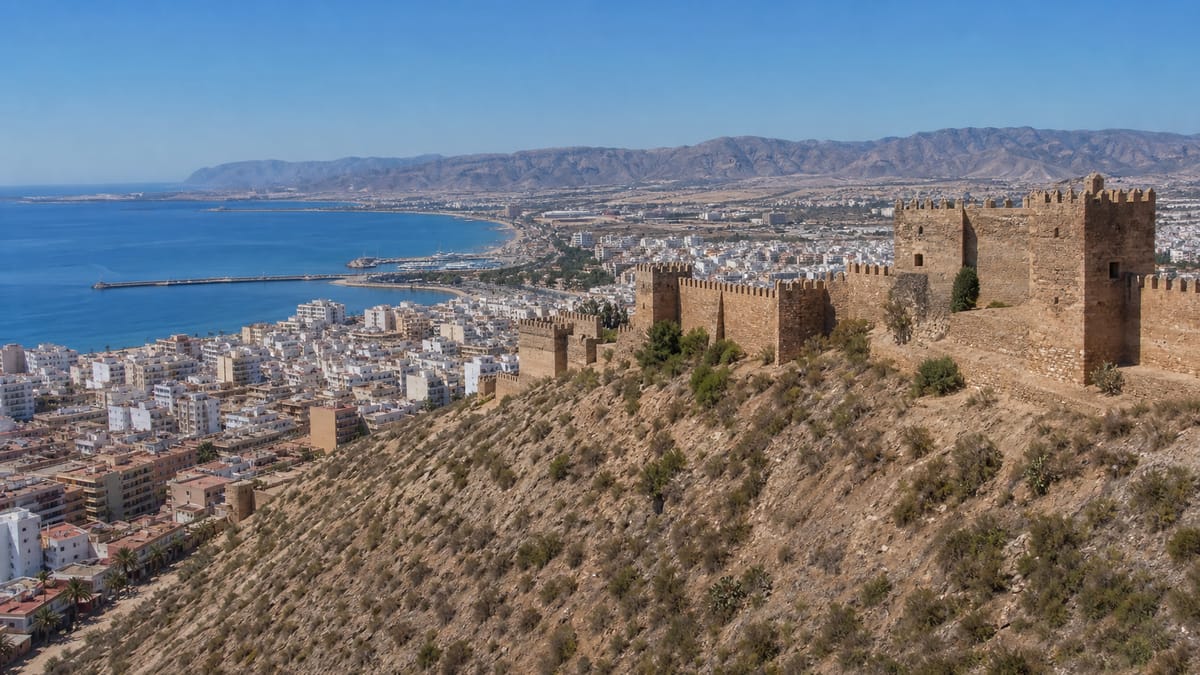
A fortified complex more than a thousand years old and one of the most extensive of al-Andalus, arranged in three enclosures: the encampment and the cisterns, the remains of the palace, and the Christian castle on the upper level. From its ramparts you grasp the city's original purpose: watching the bay. Today's gardens come largely from twentieth-century restorations; enjoy them as landscape, not as archaeology.
2 · The Almedina
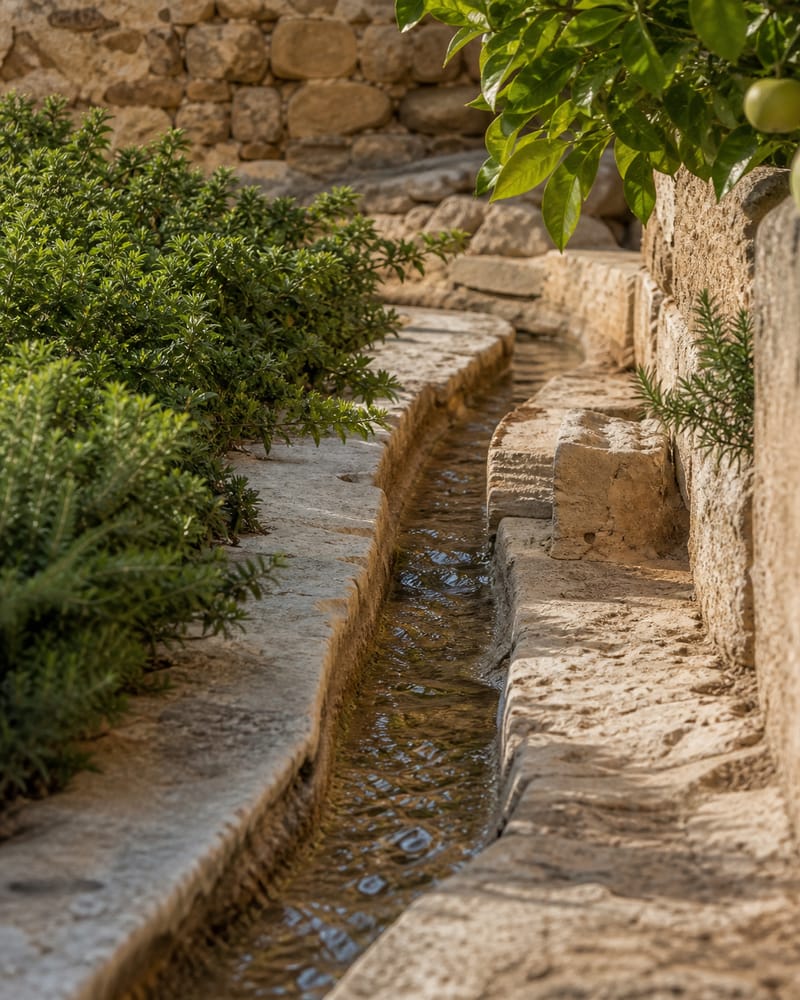
The oldest quarter keeps the layout of the medina: narrow streets, low houses, silence and sudden views of the fortress. The church of San Juan stands on the site of the former great mosque, elements of which survive; close by, the Aljibes de Jayrán (Jayrán's cisterns) recall the sophisticated water network of the eleventh century.
3 · The Cathedral
The fortress cathedral of the Incarnation sums up Almería's sixteenth century: late Gothic and Renaissance within, battlements without, and the Sol de Portocarrero on its eastern wall.
4 · Puerta de Purchena and the Paseo
The social crossroads of the bourgeois city: historic shops, eclectic façades and the start of the Paseo de Almería, running straight down to the sea between cafés and theatres.
5 · The Cable Inglés
The walk ends in iron: the loading pier strides out over the water like a suspended railway jetty. At sunset, its riveted silhouette against the bay is one of the most recognisable images of contemporary Almería.
Beyond the main axis: the Jayrán wall and the Cerro de San Cristóbal offer the best urban viewpoint; the sanctuary of the Virgen del Mar keeps the city's patron saint; Plaza Vieja gathers the town hall and the memory of Los Coloraos; and the central market and the fishing port join heritage to daily life. The Pescadería and La Chanca neighbourhoods deserve a visit with the same respectful eye as any lived-in quarter.
Museums to understand the city
The museum network allows several readings of Almería:
- Museo de Almería: the provincial archaeological reference, with Los Millares and El Argar at the heart of the story.
- Refugios de la Guerra Civil: the underground visit to the galleries of 1937.
- Alcazaba de Almería: the monument itself as an open-air museum.
- Museo de la Guitarra Antonio de Torres: the luthier who fixed the form of the modern guitar, born in La Cañada, within the municipal boundaries.
- Casa del Cine: the film shoots and John Lennon's stay in 1966.
- Doña Pakyta and MUREC: Almería's art and contemporary Spanish realism.
- Centro Andaluz de la Fotografía and Centro de Interpretación Patrimonial, alongside the Aljibes Árabes and the house of the poet José Ángel Valente.
Opening hours, fees and visiting conditions change with the seasons: always check them on the official pages linked in the sources.
Sources
This guide synthesises institutional sources; the specific data (dates, shelter figures, heritage listings) come from them.
- Turismo de Almería — History of the city
- Turismo de Almería — Al-Mariyat Bayyana, the Muslim era
- Turismo de Almería — The Christian conquest
- Turismo de Almería — The nineteenth century
- Turismo de Almería — The Civil War Shelters
- Turismo de Almería — The Alcazaba
- Turismo de Almería — The Cable Inglés
- Turismo de Almería — Jayrán wall and Cerro de San Cristóbal
- Turismo de Almería — Museum network