Why cinema chose Almería
The production companies did not arrive by chance. From the late 1950s, film crews found in Almería three things that are hard to bring together in one place: a stable, clean light for most of the year — AEMET's climate normals record close to three thousand hours of sunshine a year at the airport station — a variety of landscapes that lets desert, sea, market gardens and old town be strung together within a few kilometres, and an architecture able to play other eras and other continents almost without scenery.
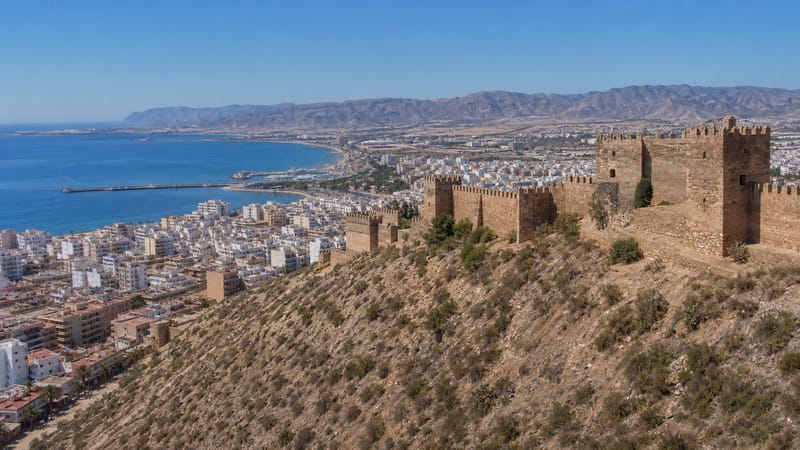
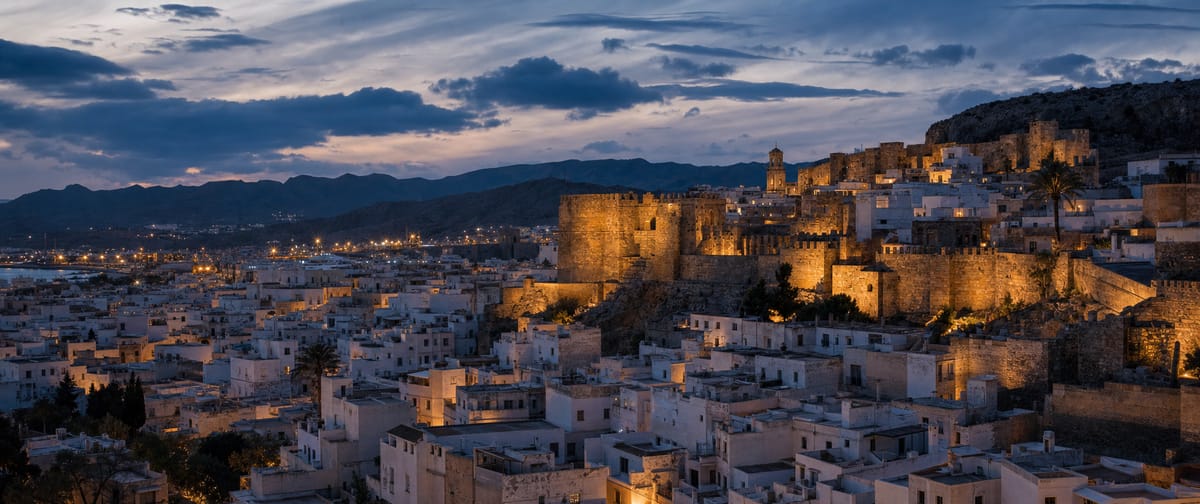
The result was a lasting relationship. First came the historical and adventure super-productions; then the western cemented the international reputation; and ever since, films, series and commercials have kept using the province and the capital as a natural film set. The city, with its millennium of built history in plain sight, offers something no studio can put up: an authentic Alcazaba, a medina of white streets and a park of palm trees beside the port.
City and province, once again. The westerns were shot above all in the Tabernas desert, which belongs to the province and not to the municipality of the capital. Reducing "Almería, land of cinema" to the westerns means keeping only one chapter: this guide is about the squares, parks and walls of the city itself, which have been changing roles in front of the camera for more than sixty years.
The city as a film set, film by film
The list of titles shot inside the city surprises even many locals. These are some of the productions with urban locations documented by the municipal film office and the tourism department:
- Lawrence of Arabia (1962): the Parque Nicolás Salmerón, the strip of palm trees between the port and the old town, forms part of the super-production that opened the way for all the others.
- Patton (1970): the Plaza de la Catedral, the Parque Nicolás Salmerón itself and the Cerro de San Cristóbal lent their stones to the general's Mediterranean campaign.
- The Wind and the Lion (1975): the park once more, together with the Casino Cultural, stood in for early twentieth-century North Africa.
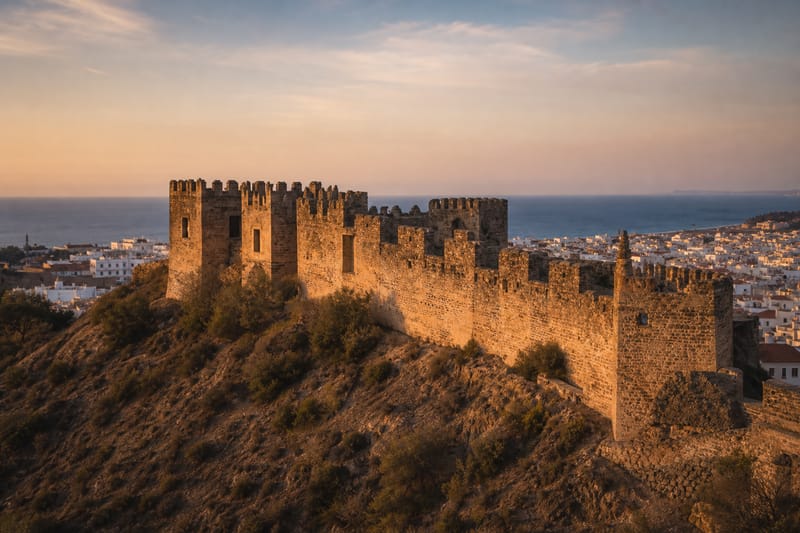
- Conan the Barbarian (1982): the Alcazaba and its walls became a stage for epic fantasy.
- Indiana Jones and the Last Crusade (1989): the Escuela de Arte and the streets of the Almedina appear in the third instalment of the saga.
- Risen and Game of Thrones: in the 2010s, the Alcazaba changed era once again, for biblical cinema and television fantasy.
- Wonder Woman 1984: filming returned to the Almedina, which added one more role to its long filmography.
And the roll keeps growing: recent productions have filmed at the salt flats, the port and the streets of the capital, from independent cinema to the streaming platforms. Anyone strolling through the salt flats of Cabo de Gata, inside the city's extensive municipal boundaries, is also walking across an intermittent film set.
The same alcazaba can be a fantasy kingdom, the Holy Land or an adventure backdrop: only the camera changes.
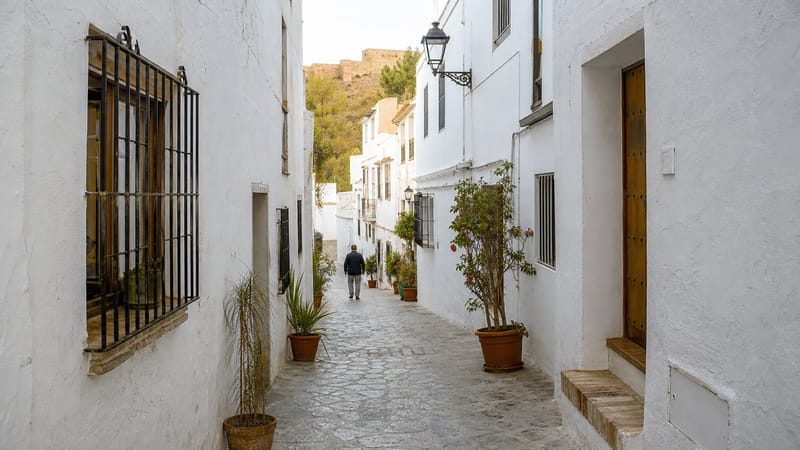
1966: John Lennon and the Casa del Cine
In the autumn of 1966, the shoot of How I Won the War settled its cast in Almería, and with it a John Lennon who had just left the stage behind with the Beatles. For several weeks he lived in a large house with a garden on what was then the edge of town, now restored as the Casa del Cine, the museum that tells the story of the city's relationship with film shoots.
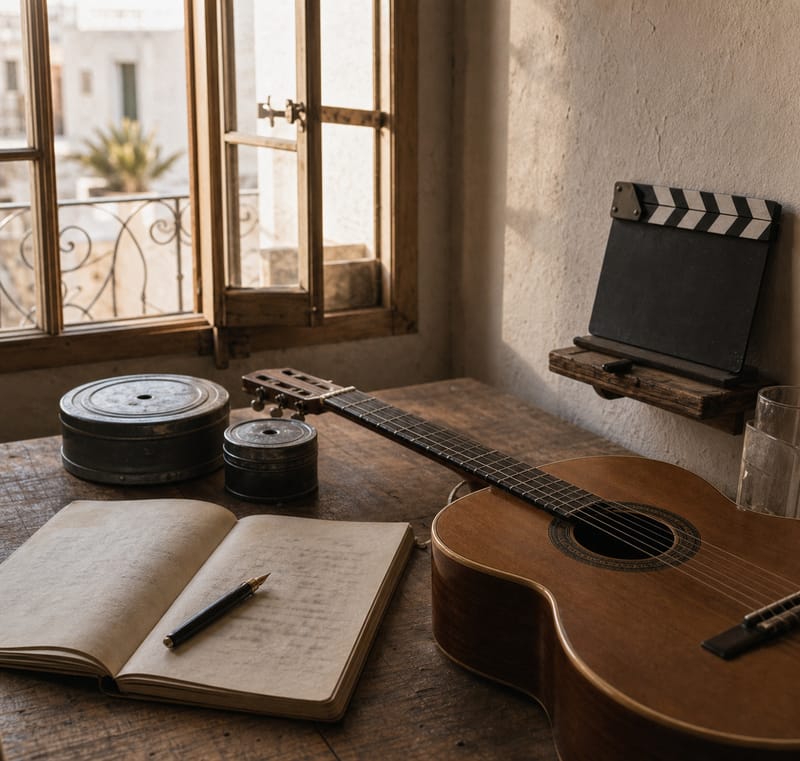
Those weeks in Almería coincide with the gestation of Strawberry Fields Forever, which Lennon began to sketch out during the shoot. The temptation to write that the song "was born in Almería" is understandable, but it should be told with caution: the stay forms part of the emotional landscape in which the piece began to take shape, and that is already enough for the city's musical memory.
The other soundtrack: Antonio de Torres's guitar
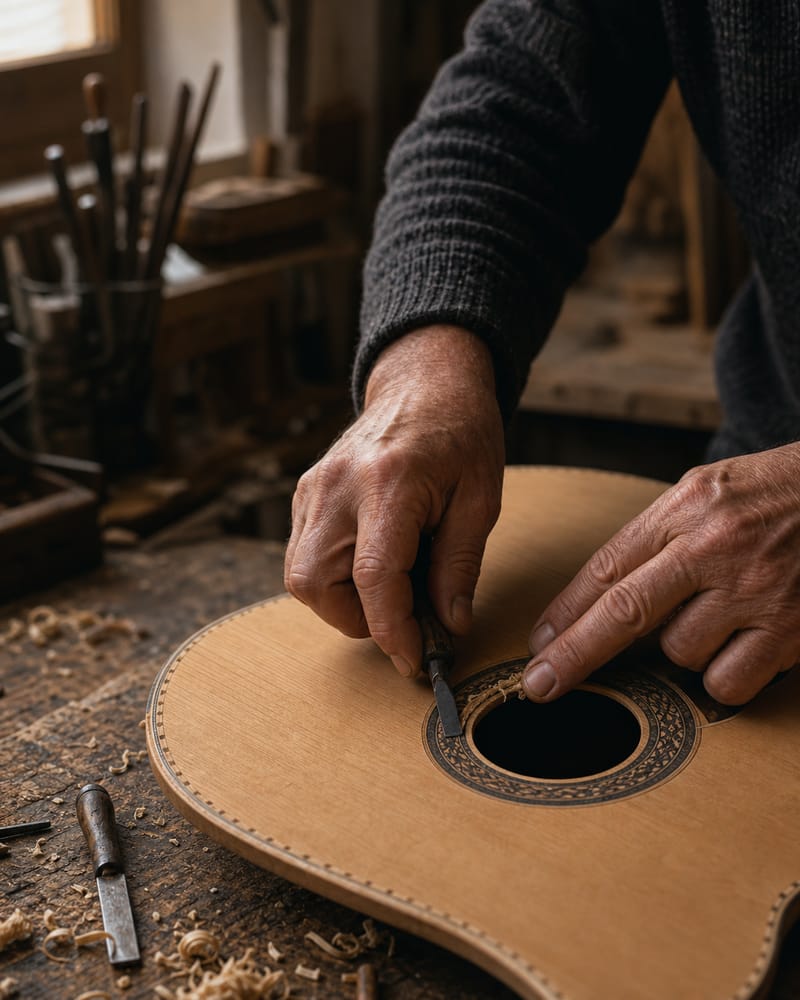
If cinema came to Almería in search of the light, the music came out of a workshop. Antonio de Torres (1817–1892) was born in La Cañada de San Urbano, today a district of the municipality of Almería between the city and the airport. A carpenter and guitar maker, he worked between Almería and Seville and signed the instruments that turned a popular utensil into the concert instrument we know today.
Torres is credited with fixing the proportions and constructive principles of the modern classical guitar: the larger body, the outline that is still copied today and the decisive attention to the soundboard as the sounding heart of the instrument. When a luthier in Tokyo, Madrid or Chicago draws a Spanish guitar today, they are still in dialogue with the measurements of that workshop.
The city keeps that thread alive in two places: the house and workshop in La Cañada, converted into an exhibition space, and the Museo de la Guitarra Antonio de Torres, in the city centre, which traces the history and construction of the Spanish guitar. Visiting conditions change with the season; check them on the official pages linked in the sources.
The flamenco of Levante: taranta and taranto
Almería's flamenco belongs to the cantes de Levante, the family of songs that grew up with the mining basins of the peninsula's south-east. From that matrix, the taranta was born in the Almería area: a free cante, without a fixed beat, carrying the deep voice of work in the mine. Its strict-rhythm form is the taranto, associated with Almería and adopted by dance as well.
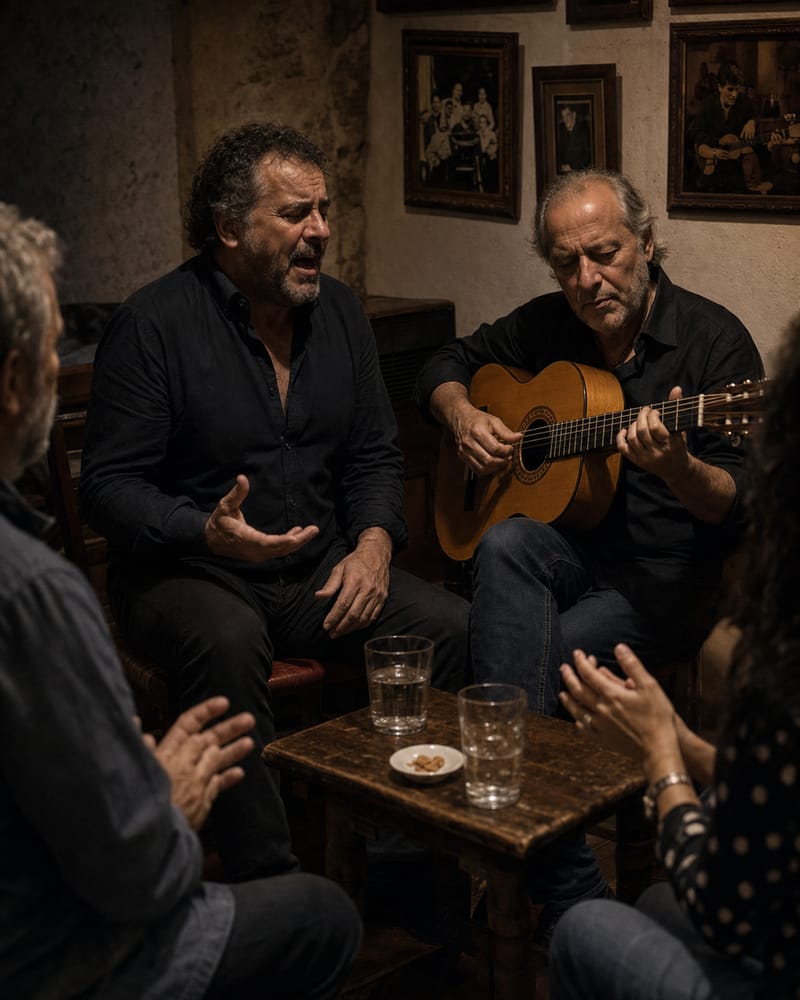
That repertoire does not live in display cases. The peñas — flamenco clubs — El Taranto and El Morato host recitals and keep a demanding afición alive, and the Festival de Flamenco y Danza adds first-rank names to the city's cultural calendar; dates and line-ups change with every edition, so check the official programme before planning your evening.
It deserves to be seen for what it is: a living, rigorous practice, not a decorative silhouette. A night at a peña — cante, guitar, silence and jaleo in just the right measure — explains the city as well as any monument, and connects with the rest of the festive and traditional calendar.
Names to know, from the classroom to the peña
Twentieth-century culture in Almería cannot be explained without a few names. Celia Viñas, a teacher and poet who arrived in the city in the 1940s, turned the classroom into an engine of cultural life for several generations. In the middle of the century, Jesús de Perceval articulated the Indaliano movement, which brought the light, landscapes and people of Almería back to the centre of an artistic language of their own; its trail can be followed today at the Museo de Arte Doña Pakyta.
The emblem that group adopted, the Indalo, comes from the province's rock art and has become a provincial symbol by adoption. It should be used with context: seeing it in the shop windows of the city centre does not make it a crest born in the capital, but a shared identity tradition belonging to the whole province.
Poetry also chose these streets: José Ángel Valente, one of the major voices of contemporary Spanish poetry, made Almería his place of retreat and writing, and his house in the Almedina can be visited today as the Casa del Poeta.
The recent soundtrack confirms that the city still plays on: the flamenco guitarists Tomatito and Niño Josele were born in Almería, as was the singer David Bisbal, raised in the city before filling international stages. Manolo Escobar, by contrast, was born in El Ejido: an almeriense from the province, not from the capital — a distinction that matters in these parts.
Seeing and hearing the city today
To turn this guide into a plan, these are the places that hold the memory of cinema and music:
- Casa del Cine: the city's film shoots and John Lennon's stay, told in the very house where he lived in 1966.
- Museo de la Guitarra Antonio de Torres: the history and construction of the Spanish guitar, in the city centre.
- Antonio de Torres's house and workshop, in La Cañada: the origin of the craft, in his home district.
- Peñas El Taranto and El Morato: the flamenco of Levante in its natural habitat.
- Alcazaba and Almedina: the main filming locations can be covered on foot in a morning.
Before you go: opening times, prices, bookings and programmes change with the seasons and the editions. This guide does not publish practical details that expire: always check the official pages linked in the sources.
If you want to fit these visits into a 24-, 48- or 72-hour route, the itineraries suggest three ways of ordering the city; and between museum and peña, few things explain Almería better than a table of tapas.
Sources
This guide synthesises institutional sources; the specific details (filming locations, museums, cantes and people) come from them.
- Turismo de Almería — Land of cinema
- Almería Film Office — Feature films shot in Almería
- Almería Film Office — The Almedina quarter
- Turismo de Almería — Casa del Cine
- Turismo de Almería — Antonio de Torres exhibition space
- Turismo de Almería — Museum network
- Andalucía.org — The taranta
- Turismo de Almería — Celia Viñas Olivella
- Turismo de Almería — Museo de Arte Doña Pakyta